What it really takes for aging parents and adult children to repair old wounds
Forgiveness and reconciliation aren’t the same thing, the Aging Untold experts say
(Aging Untold) — As parents age, some might hope for a closer relationship with their adult children.
Repairing those relationships takes more than good intentions — it takes ownership, patience and realistic expectations.
“Forgiveness takes one person, but a relationship takes more than one”
Gerontologist “Sam” Cradduck said families need to understand upfront that they can’t control how the other side responds.
“I think it’s real important to understand that forgiveness takes one person, but a relationship takes more than one,” Cradduck said. “And if they’re not willing, there’s not a whole lot you can do.”
Cradduck added that many long-running family conflicts have lost their origin story entirely.
“Sadly, most of these disconnects, nobody knows what caused it,” Cradduck said. “They’ve been mad for so long, and they’ve lived this life in anger for so long, they don’t even know what happened to start it all.”
Her advice for the parent who may have caused the pain: own it.
“If you’re the person that maybe offended them, be willing to apologize. Be willing to own what you did wrong,” Cradduck said. “And if they’re not willing to accept that apology, you’ve done your part. You can’t be responsible for somebody else in a relationship — you can be responsible for yourself.”
A real apology has three parts
Dr. Rhea Rogers, a board-certified physician, said time alone doesn’t heal old wounds — and a genuine apology requires more than saying sorry.
“Time doesn’t automatically heal the pain. Just because 30 years have passed doesn’t mean the pain passed,” she said.
Rogers broke down what a real apology requires.
“When you have an apology, it has three parts to it: you want to acknowledge the harm, you want no excuses, and you need changed behavior,” Rogers said. “But the healing happens on the injured person — the person who was hurt, it’s on their timeline, not yours. The healing is the peace — but the reconciliation is the trust process and the relationship.”
- Acknowledge the harm
- Make no excuses
- Change your behavior
Sometimes the real conflict isn’t the one you think it is
Aging expert Amy O’Rourke shared an example from her own consultations about a client who had spent years resenting his father over how his mother had been treated — and became fixated on getting his dad to bring his mom coffee every morning.
“I said, well, maybe it’s more about you and your own feelings than it’s really their marriage,” O’Rourke said. “So he went into therapy and discussed his own resentments that were not attached to his parents at all — and he ended up telling me that his relationship with his partner got better for what he learned about himself.”
O’Rourke said the experience points to a broader lesson about self-awareness.
“What you think the conversation you need to have might not be the conversation you need to have,” O’Rourke said.
Estrangement is common — and complicated
Aging well coach Katherine Ambrose said that estrangement between older adults and their relatives has become increasingly common.
“There’s a lot of older adults living with serious pain from estrangement. It’s almost like a popular culture thing to be estranged from relatives,” Ambrose said. “And it’s very, very sad.”
Her advice to an older adult who feels cut off from family: let go of what you can’t control.
“You can’t make them change their mind or do anything. Honestly, I just say, pray about it, because something can change just like that,” Ambrose said. “And it could happen suddenly. And sometimes, maybe they did do something wrong, but sometimes maybe they really didn’t.”
Cradduck added that the only thing somebody can do is apologize and try to explain where they were at, or where they came from, or how it happened.
“And it’s on you then to either accept that and move forward, or to not. It’s your choice,” she said.
She added a reminder about grace.
“Someday you’re also going to need grace,” Cradduck said.
Don’t have the hard conversation when you’re angry
O’Rourke also offered practical advice for when emotions run high.
“If you’re really, really upset, you’re really hot, you’re really mad — don’t talk to them then,” O’Rourke said. “Let yourself cool down, get some objectivity.”
She recalled a friend whose daughter repeatedly raised complaints about her mothering, even after her mother felt she had done all she could.
“My friend said, ‘Well, I hope you get a really good therapist for that,’” O’Rourke said. “Because she really had resolved that she’d done all she could do, and she could really see that it was on her daughter that needed the help.”
O’Rourke noted that estrangement isn’t always literal distance.
“You might not be estranged, but you might feel emotionally estranged,” O’Rourke said.
Key takeaways
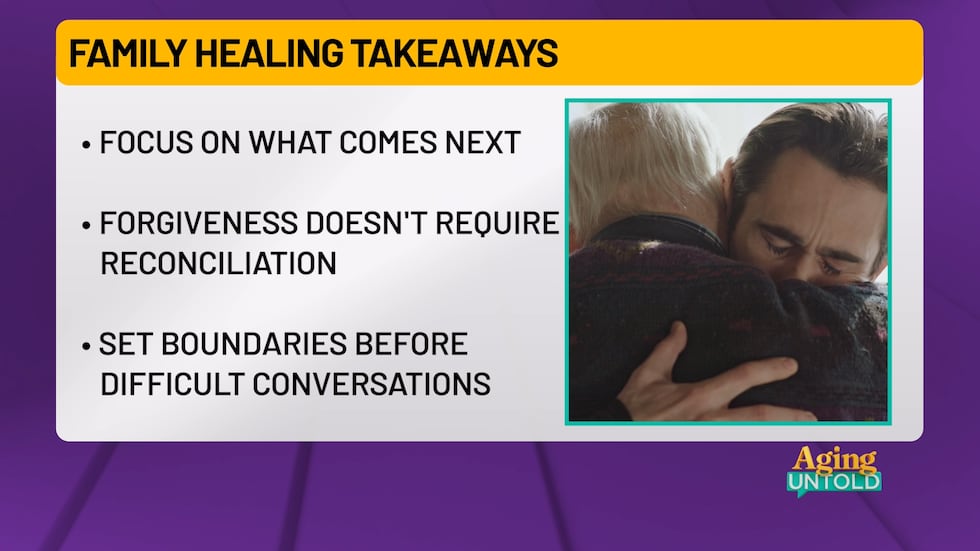
- Aging well means deciding what comes next — not rewriting old battles.
- Forgiveness and reconciliation are different. Forgiveness brings individual peace; reconciliation requires shared trust and real accountability.
- A genuine apology has three parts: acknowledging the harm, avoiding excuses and showing changed behavior.
- Healing happens on the hurt person’s timeline — not the timeline of the person who caused the pain.
- Set healing boundaries. Cool down and gain objectivity before starting emotionally charged family conversations.
Copyright 2026 Gray Media Group, Inc. All Rights Reserved.