Complaints grow in Georgia over required special education services
State records show formal complaints against school districts more than doubled since 2021
ATLANTA, Ga. (InvestigateTV) - Free education for all is a part of the fabric of American life and 50 years ago Congress made sure that meant children with disabilities too with the passage of the Individuals with Disabilities Education Act.
But some states are falling short when it comes to the minimum requirements for the law. In 2023, just 22 states were in compliance, according to the Department of Education.
One state that has failed to meet the standards for special education in Georgia.
A growing number of Georgia parents allege their school districts are violating the law by failing to provide required special education services, according to an Atlanta News First investigation.
Georgia Department of Education records show formal complaints against school districts have more than doubled in recent years, from 156 in 2021 to 318 last year.
In fiscal year 2025, the state found districts were out of compliance 190 times.
The surge in complaints reflects several concerning trends identified by the Georgia Department of Education’s dispute resolution division.
A 2025 presentation produced by the division showed more complaints are being filed by current school staff; more complaints are being filed in districts that historically had few complaints; and more complaints involve multiple students, indicating systemic issues.
The most common violations found in fiscal year 2025 involved the provision of a free appropriate public education, implementation of individualized education programs, as well as development, review and revision of Individualized Education Programs (IEPs).
An IEP is a legally binding document that outlines specialized instruction, goals, services, and accommodations for students with disabilities.
It’s a customized plan, developed by a team including parents, teachers, and specialists, detailing how the school will meet a specific child’s unique learning needs to help them succeed academically.
Robyn Painter, an attorney who represents Georgia families with disputes against districts, said she’s getting more calls from parents than her law firm can handle.
“We’re not talking about a child who may just need extended time on tests,” said Painter, who worked at the U.S. Department of Education for a decade. “People don’t call me unless they’re facing real situations. Unfortunately, I’ve had to turn people away.”
Fayette County family’s battle
The complaint data includes families like Chip Glazier, whose dispute with the Fayette County School District exemplifies the struggles parents face when advocating for their special needs children.
Glazier has spoken at nearly every Fayette County school board meeting over the past nine months, demanding the district provide his 18-year-old daughter Megan with a one-on-one paraprofessional and other accommodations.
Megan has a rare cognitive gene disorder - atypical Prader Willi syndrome - that affects her ability to learn and impacts her eating habits.
“Megan’s brain doesn’t talk to her stomach,” Glazier said. “She could eat herself to death if left unchecked.”
For four years, Glazier and his wife have asked the district to provide their daughter with the one-on-one support throughout the school day. Glazier said the resource is required under federal law and provided by other districts to students with similar needs.
The district has repeatedly denied their request. “They do everything in their power to not provide the services required by a free and appropriate education,” Glazier said.
Allegations of retaliation
Glazier hired an attorney in 2022 to try to resolve the dispute. Afterward, he claims the district stopped cooperating with Megan’s IEP and delayed meetings.
Then, something unexpected happened: a visit from Georgia Child Protective Services (CPS) to investigate alleged maltreatment.
According to agency records, the school district alerted CPS because “Megan pulled the fire alarm” and made “suicidal statements.” The district claimed her parents refused to take their daughter for a mental health evaluation.
“That is 100% false,” Glazier said. “They knew we had an appointment the next week, and we told them that.”
He said he was stunned and embarrassed when state investigators came to his home.
“But then you realized why it happened, and it’s all in a series of retaliatory processes against us because we advocate for our child,” he said.
Painter said the district’s actions are typical.
“I was not surprised,” she said. “I see that with parents whose child, for whatever reason, is posing a difficulty with the district.”
CPS declined to pursue the case against Glazier and his wife.
The Fayette County School District declined comment. “At this time, we respectfully decline an interview,” said Melinda Berry Dreisbach, the district’s public information officer. “Should that change in the future, we will be in touch.”
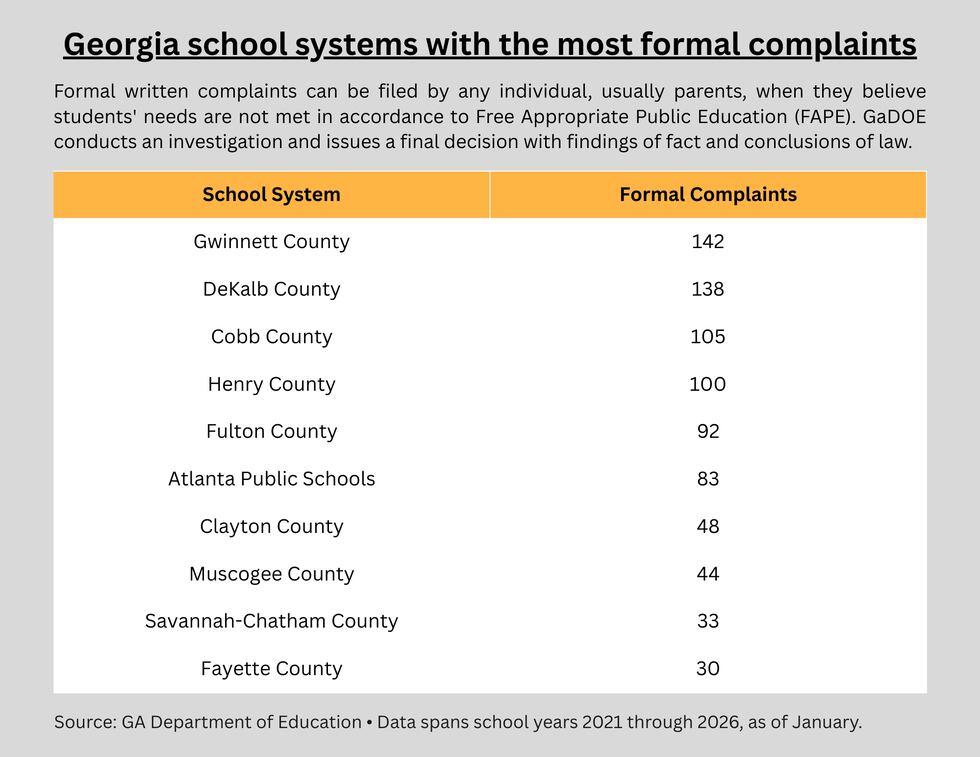
According to records from the Georgia Department of Education, at least 30 formal complaints have been submitted against Fayette County School District over the past five years.
That puts the district in the top 10 in the state for the total number of complaints.
Implementation failures statewide
The state’s formal complaint data reveals potential widespread implementation failures across Georgia school districts.
In fiscal year 2025, the most frequent violations involved districts failing to implement IEPs as written, particularly speech-language services.
Seven violations for implementation were due to failure to provide speech services, with four violations attributed to staff shortages or speech-language pathologist vacancies.
Districts also failed to provide required progress reports to parents and lacked documentation that students received special education services as outlined in their IEPs.
Other common violations included failure to consider parent concerns when developing IEPs, improper data collection on annual goals, and lack of appropriate behavioral interventions when concerns escalated.
Copyright 2026 Gray Media Group, Inc. All rights reserved.